Interdisciplinary Approaches in Cancer Research
Cancer research is among the most complex scientific domains, where progress relies on the integration of multiple disciplines. Big data, computational methods, and mathematical modeling serve as key tools for understanding tumor biology, enabling more accurate predictions and more refined interpretations of biomedical mechanisms.
Internationally, the integration of fields such as biology, computer science, mathematics, and medicine is increasingly recognized as a driver of innovation in multidimensional health challenges. Interdisciplinary collaboration enhances knowledge exchange across domains and supports more comprehensive and evidence-based research approaches, while advancing modern scientific methodologies and academic directions.
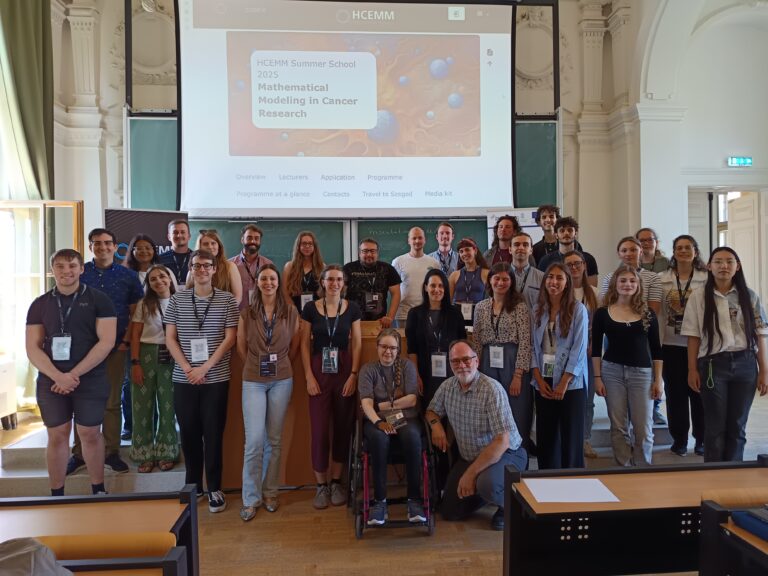
One important program applying these methodologies was the Interdisciplinary Summer School on Mathematical Modeling in Cancer Research, organized by the National Laboratory for Health Security and the Hungarian Centre of Excellence for Molecular Medicine – Translational Medicine (HCEMM), and held at the University of Szeged. The program brought together researchers and professionals from diverse scientific backgrounds, fostering a strongly interdisciplinary environment in which mathematical modeling, biology, and computational methods converge to address complex challenges in cancer research.
Such initiatives elevate scientific expertise, strengthen research networks, and support the development of the next generation of scientists in a field critical to public health. They create opportunities for individuals from different scientific areas to collaborate with a shared purpose, facilitate intellectual exchange, and enable collective exploration through quantitative and computational approaches, contributing to a deeper understanding of biomedical questions and to the advancement of cancer research.
Theoktisti Ntoumani participated in the program as part of her research activity in the field of cancer.